Belgium has two things that Los Angeles doesn't have: seasons and weather. Lots of weather. Between the cold temperatures in wintertime (not to mention early spring and late fall) and rain pretty much year-round, that leaves few really good days. You know... warm and sunny with clear, blue skies. The kind of weather Los Angeles has all the time.
So when they do get good weather, Belgians really know how to take advantage of it. One way they make the most of nice day, especially during the summer (when the sun doesn't set until around 10 o'clock) is to find a café or restaurant with an outdoor patio, gather some friends and just... hang out.
There could be a meal involved, but it could be just drinks--alcoholic or not. The point is simply to sit outdoors, sipping a beverage or eating something as the inclination strikes, but mainly... enjoying the weather, your friends and the ambiance, as everyone around you is pretty happy about the nice weather too.
In Dutch this is called "een terrasje doen." Literally translated, it means "doing a little terrace." We don't really have an equivalent expression in English. When people ask me what we say in the States, the best I can come up with is "going to a restaurant or café with outdoor seating and getting a table on the patio and hanging out with friends while having a drink or possibly a meal." The Dutch is much more concise.
Everywhere you go this time of year, you see tables set up on the sidewalk, in city plazas and on rear patios of every restaurant. Most places seem to double, if not triple, their seating capacity during the warmer months. And if the sun is shining, every seat will be filled. Now that it's August and fall is around the corner, we're already thinking our days of terrasje doen are numbered. Until next year.
Thursday, August 5, 2010
Thursday, July 15, 2010
Milk
There's something that has confused and bothered me ever since I got here. I thought it odd that all the milk for sale in the grocery stores was sold unrefrigerated. You can store it that way for months, and once it's opened, it will keep in the fridge for weeks and weeks. I'm not sure how long it will stay "fresh" since I've yet to have one of those boxes go bad.
It doesn't go bad because it's ultra-pasteurized; the process is also called UHT, for ultra-high temperature.The milk we drink in the States is merely pasteurized and needs to be refrigerated. It will also go bad in a week or two even when keep cold. (Sometimes cream and half-and-half are ultra-pasteurized to make them last longer in the fridge.)
Personally, I'm suspicious of ultra-pasteurized milk. It tastes weird, and--Hello! Milk is supposed to go bad! It's milk. So when it doesn't need to be refrigerated, I'm thinking that it's not really milk anymore, if you know what I mean.
The thing that's really weird about this situation is that Belgium is full of dairy cows. You can't drive 10 kilometers in any direction without seeing some nice, contented cows standing around in a beautiful green pasture. There are cows right in Hasselt, within the city limits. I figured there must be a way to get real milk around here.
I picked up a map at the tourist information office that's labeled "Fairtradeplan" and shows the locations of various organic and fair trade businesses around town. It listed one place that sells "verse hoevemelk" not far from my boyfriend's work, and yesterday I went looking for it after dropping him off at the office.
Success! There, on a main street leading out of the city center, was a small dairy farm. I pulled into the driveway and parked between an open barn full of cows standing around in large pens with clean hay and a brick building full of what looked like modern milking equipment.
A man came out of the suburban house next door and, when I said I was looking for fresh milk, asked me if I'd brought a bottle. I hadn't, so he went back inside the house and got an empty plastic water bottle. Then we went into the brick building and he filled the bottle from a giant stainless-steel vat. It cost me 1 Euro for a liter and a half.
Now that I know how easy it is to get real milk, I'm never drinking UHT milk again! I have a friend here who says she usually goes to Holland to get fresh (normal, pasteurized) milk so I told her about the dairy farm. My Belgian boyfriend is suspicious, though. He thinks that if it can go bad, it can't be good.
It doesn't go bad because it's ultra-pasteurized; the process is also called UHT, for ultra-high temperature.The milk we drink in the States is merely pasteurized and needs to be refrigerated. It will also go bad in a week or two even when keep cold. (Sometimes cream and half-and-half are ultra-pasteurized to make them last longer in the fridge.)
Personally, I'm suspicious of ultra-pasteurized milk. It tastes weird, and--Hello! Milk is supposed to go bad! It's milk. So when it doesn't need to be refrigerated, I'm thinking that it's not really milk anymore, if you know what I mean.
The thing that's really weird about this situation is that Belgium is full of dairy cows. You can't drive 10 kilometers in any direction without seeing some nice, contented cows standing around in a beautiful green pasture. There are cows right in Hasselt, within the city limits. I figured there must be a way to get real milk around here.
Success! There, on a main street leading out of the city center, was a small dairy farm. I pulled into the driveway and parked between an open barn full of cows standing around in large pens with clean hay and a brick building full of what looked like modern milking equipment.
A man came out of the suburban house next door and, when I said I was looking for fresh milk, asked me if I'd brought a bottle. I hadn't, so he went back inside the house and got an empty plastic water bottle. Then we went into the brick building and he filled the bottle from a giant stainless-steel vat. It cost me 1 Euro for a liter and a half.
Now that I know how easy it is to get real milk, I'm never drinking UHT milk again! I have a friend here who says she usually goes to Holland to get fresh (normal, pasteurized) milk so I told her about the dairy farm. My Belgian boyfriend is suspicious, though. He thinks that if it can go bad, it can't be good.
Saturday, June 19, 2010
Hagel Slag
This post is long overdue. I can't believe I haven't written about Hagel Slag before now! (I think I overlooked it because I already introduced all my friends in L.A. to it when I was back there visiting a couple of months ago.)
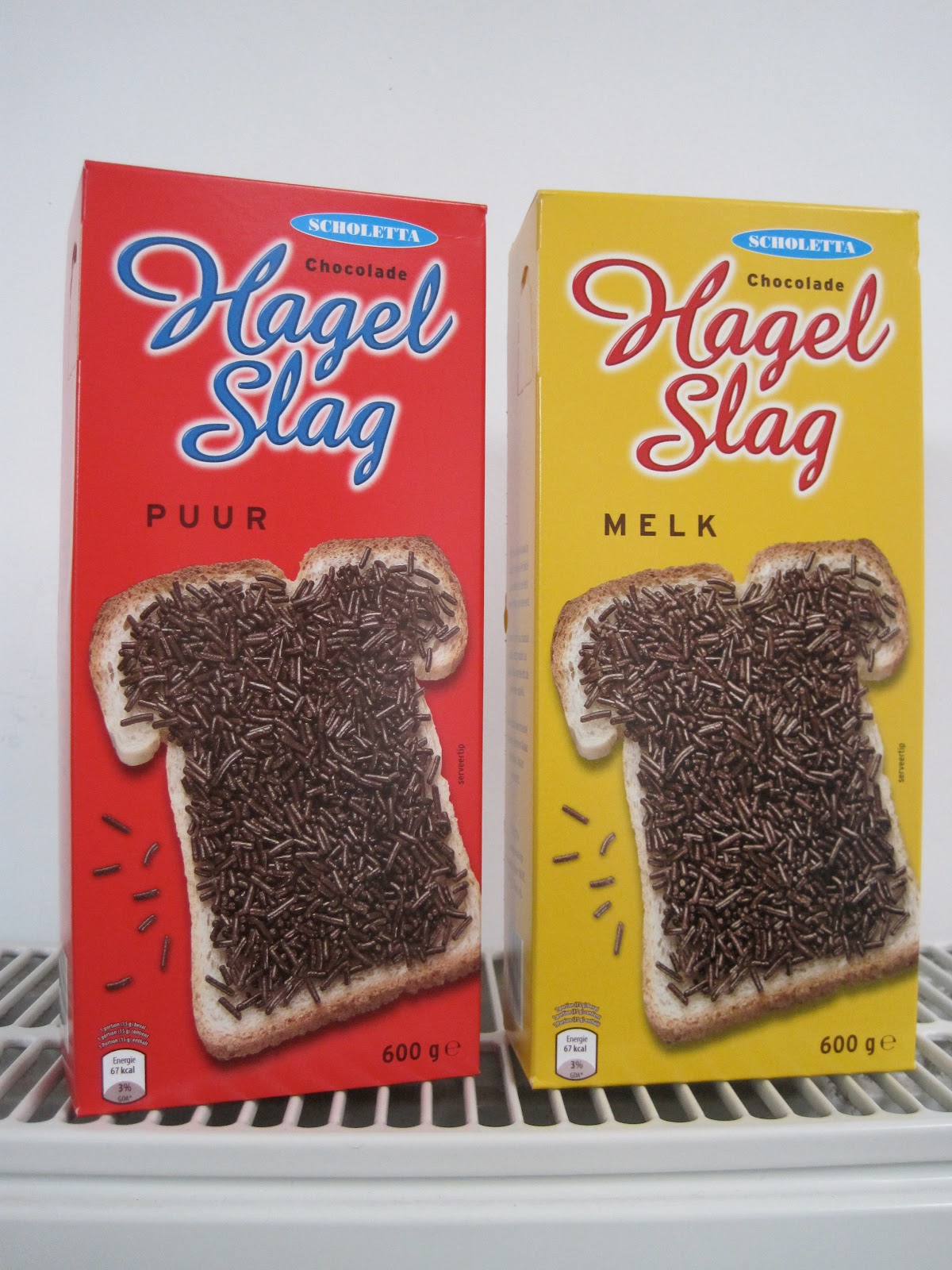
Hagel Slag is what's known in the U.S. as chocolate sprinkles--the kind you buy in small quantities (if you bake) to put on cupcakes, or maybe ice cream sundaes. You can also find them on donuts. Usually they're used as a decoration, a finishing touch, if you will.
Well, Belgians have found a much larger gustatory purpose for the lowly chocolate sprinkle. Here, it's sold in large boxes (400-500 g) and used as a topping for bread or a sandwich filling, usually for breakfast. ("Hagel slag" means hail storm. Go figure.)
What you do is you take a slice of bread (or a roll) and spread it with butter, and then load it up with a solid layer of sprinkles. Voilà! Breakfast is served--or maybe lunch. You and I might call this "crazy" but I know at least one American who thinks it's "genius." A Belgian, of course, thinks it's normal.
Hagel Slag is what's known in the U.S. as chocolate sprinkles--the kind you buy in small quantities (if you bake) to put on cupcakes, or maybe ice cream sundaes. You can also find them on donuts. Usually they're used as a decoration, a finishing touch, if you will.
Well, Belgians have found a much larger gustatory purpose for the lowly chocolate sprinkle. Here, it's sold in large boxes (400-500 g) and used as a topping for bread or a sandwich filling, usually for breakfast. ("Hagel slag" means hail storm. Go figure.)
What you do is you take a slice of bread (or a roll) and spread it with butter, and then load it up with a solid layer of sprinkles. Voilà! Breakfast is served--or maybe lunch. You and I might call this "crazy" but I know at least one American who thinks it's "genius." A Belgian, of course, thinks it's normal.
Saturday, June 12, 2010
Elections tomorrow
Tomorrow is election day in Belgium and everyone I know will go to the polls. That's because voting is mandatory here, and has been since 1892. Belgium has the oldest compulsory voting system in the world.
By law, you must enter the polling booth, but since the act of voting is still private and confidential, you don't have to mark a ballot.
After an election, a list of non-attendees is sent to the public prosecutor. Penalties for non-participation without a good excuse (like being in the hospital or out of the country) range from a small fine for a first offense to losing your right to vote for 10 years.
And unlike the U.S., which holds elections on a weekday, Belgium has elections on a Sunday morning when people aren't at work. (Very few businesses are open on Sundays here, and I bet even those are closed tomorrow.)
I did a little research online and found that voter turnout in Belgium is regularly over 90%, unsurprisingly, compared to U.S. voter turnout, which has hovered around 50% (during presidential election years) in recent decades but rose in 2008 to 68%.
You may have heard that Belgium's coalition government collapsed back in April, which is why they're having elections now. At stake is the future of the 200-year-old marriage between Dutch-speaking Flanders and Francophone Wallonia.
The AP has a good summary of the issues and major players in tomorrow's election. I'm not eligible to vote here yet, but I plan to go to the polls and observe the voting process.
By law, you must enter the polling booth, but since the act of voting is still private and confidential, you don't have to mark a ballot.
After an election, a list of non-attendees is sent to the public prosecutor. Penalties for non-participation without a good excuse (like being in the hospital or out of the country) range from a small fine for a first offense to losing your right to vote for 10 years.
And unlike the U.S., which holds elections on a weekday, Belgium has elections on a Sunday morning when people aren't at work. (Very few businesses are open on Sundays here, and I bet even those are closed tomorrow.)
I did a little research online and found that voter turnout in Belgium is regularly over 90%, unsurprisingly, compared to U.S. voter turnout, which has hovered around 50% (during presidential election years) in recent decades but rose in 2008 to 68%.
You may have heard that Belgium's coalition government collapsed back in April, which is why they're having elections now. At stake is the future of the 200-year-old marriage between Dutch-speaking Flanders and Francophone Wallonia.
The AP has a good summary of the issues and major players in tomorrow's election. I'm not eligible to vote here yet, but I plan to go to the polls and observe the voting process.
Tuesday, May 18, 2010
Let's recycle!
A few weeks ago I went to the container park for the first time. That's what everyone calls the municipal recycling center, although the correct word for it in Dutch apparently is "recyclagepark."
There's some curbside pickup here in Hasselt, mainly for green waste (and regular trash, of course). But for most household recycling, you have to bring it to the container park yourself. I'd been hearing about this place for months and was curious about how it works. So I was pretty excited when I finally had the chance to go and see for myself!
We went on a Saturday morning, having loaded up the car with our bottles, cans, cardboard and styrofoam (left over from IKEA furniture purchases). You have to insert your Belgian identity card at the gate in order to get in, and then you drive in and park your car. There were lots of other cars there already, disgorging fellow residents and their recyclables.
There were some city workers there to help things along, but for the most part everyone was bringing their own recycling to the correct dumpster or compacter. It was so orderly and organized! There were separate collection points for paper and cardboard, clear and colored glass, and PMD, which stands for Plastic bottles, Metal cans and Drink cartons.
Needless to say, I was very impressed with how well the system seems to work, especially since it's all self-service. I'm sure the other people dropping off their recycling thought I was mad, taking pictures of trash. But I was having a great time! Recycling in Belgium is fun!
There's some curbside pickup here in Hasselt, mainly for green waste (and regular trash, of course). But for most household recycling, you have to bring it to the container park yourself. I'd been hearing about this place for months and was curious about how it works. So I was pretty excited when I finally had the chance to go and see for myself!
We went on a Saturday morning, having loaded up the car with our bottles, cans, cardboard and styrofoam (left over from IKEA furniture purchases). You have to insert your Belgian identity card at the gate in order to get in, and then you drive in and park your car. There were lots of other cars there already, disgorging fellow residents and their recyclables.
There were some city workers there to help things along, but for the most part everyone was bringing their own recycling to the correct dumpster or compacter. It was so orderly and organized! There were separate collection points for paper and cardboard, clear and colored glass, and PMD, which stands for Plastic bottles, Metal cans and Drink cartons.
Needless to say, I was very impressed with how well the system seems to work, especially since it's all self-service. I'm sure the other people dropping off their recycling thought I was mad, taking pictures of trash. But I was having a great time! Recycling in Belgium is fun!
Thursday, May 13, 2010
Chocolate. It's what's for breakfast.
Belgium is known for its chocolate, right? I mean, no one's surprised to hear that the chocolate here is really good, or that people eat a lot of it. But maybe you didn't know how it's eaten much of the time.
For breakfast.
That's right. Breakfast. We Americans tend to think of chocolate as a dessert, or maybe a snack. It's not generally considered a major food group or the main component of a meal. I had no idea how limiting this thinking was until I moved here!
For instance, I always thought that chocolate cereal was for kids. Sure, adults can eat Cocoa Puffs, but you do so knowing that you're eating something created for and marketed to children. And that your mother would not approve.
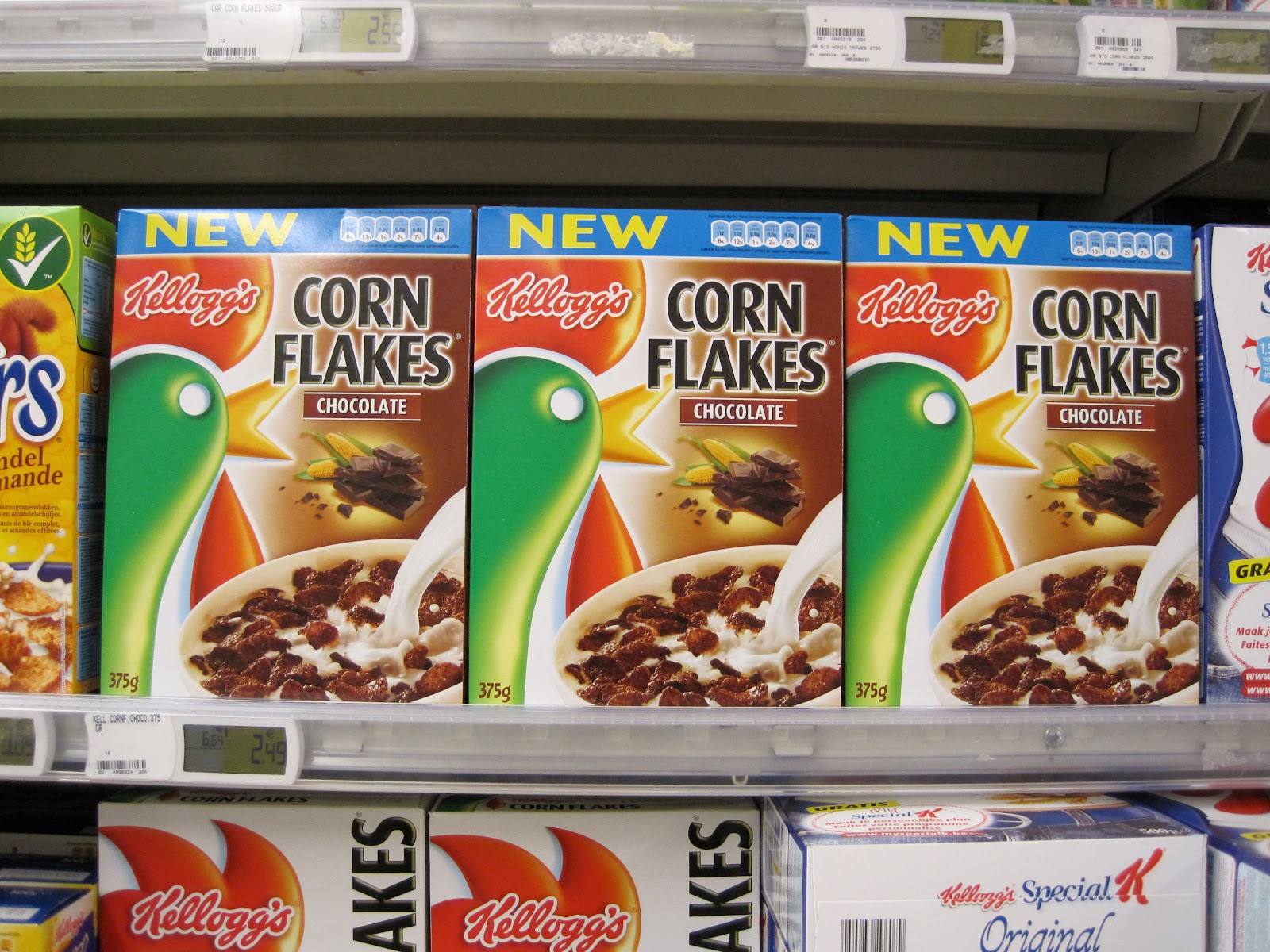
So imagine my surprise--nay, delight--when I saw the cereal aisle of the grocery store and learned that fully half of them contained chocolate, and not just the ones meant for kids! Not only that, but most come in two varieties, milk and dark chocolate!
If you live in the States, you should know that you're being deprived of the opportunity to eat chocolate corn flakes. From Kellogg's! Even the American brands of cereal have chocolate versions here. Chocolate Special K! Yeah, the diet cereal. It comes in chocolate flavor.
For breakfast.
That's right. Breakfast. We Americans tend to think of chocolate as a dessert, or maybe a snack. It's not generally considered a major food group or the main component of a meal. I had no idea how limiting this thinking was until I moved here!
For instance, I always thought that chocolate cereal was for kids. Sure, adults can eat Cocoa Puffs, but you do so knowing that you're eating something created for and marketed to children. And that your mother would not approve.
So imagine my surprise--nay, delight--when I saw the cereal aisle of the grocery store and learned that fully half of them contained chocolate, and not just the ones meant for kids! Not only that, but most come in two varieties, milk and dark chocolate!
If you live in the States, you should know that you're being deprived of the opportunity to eat chocolate corn flakes. From Kellogg's! Even the American brands of cereal have chocolate versions here. Chocolate Special K! Yeah, the diet cereal. It comes in chocolate flavor.
Tuesday, May 4, 2010
It's not pizza, it's your mail
The other day I was out riding my bike with a friend and we passed a woman on a red scooter with a big box mounted on its back. I recognized the Belgian post office logo and realized that she was delivering the mail!
I was so excited that my friend turned around and chased her down so that I could take a picture. She asked if I was visiting and I had to admit that I live here, but clearly I still act like a tourist.
I told her that I'd never seen the mail delivered via scooter before. She was by far the cutest mail-delivery person I've ever seen. My friend agreed, and later wanted to know if I'd gotten her number when I took her picture.
I was so excited that my friend turned around and chased her down so that I could take a picture. She asked if I was visiting and I had to admit that I live here, but clearly I still act like a tourist.
I told her that I'd never seen the mail delivered via scooter before. She was by far the cutest mail-delivery person I've ever seen. My friend agreed, and later wanted to know if I'd gotten her number when I took her picture.
Subscribe to:
Posts (Atom)