Showing posts with label food. Show all posts

Thursday, December 12, 2013

Home for the holidays

In a couple of days my husband and I will board a plane for the States, where we'll visit friends and celebrate the Christmas holidays with my family. It'll be the first time in three years that we're back in the USA for Christmas, and I can't wait.

Not that I don't enjoy the holiday season here in Belgium. The old Flemish cities are at their picturesque best this time of year, with all the Christmas greenery and lights. Christmas markets are sprouting up everywhere, and I've already drunk my fill of mulled wine, whipped cream-topped hot chocolate and flavored jenevers at Hasselt's Winterland, which is like a sugar-fueled, Santa-themed carnival on acid.

Hasselt's Winterland

But there's something special about Christmas in America, and it's just not the same here. No other holiday comes close in terms of nostalgia, anticipation, excitement and excess. Christmas isn't only the biggest holiday of the year—it's the one that is most closely bound up with our childhood memories, our family dynamics, and our favorite rituals, whether religious or secular.

Of course, there are all the negatives: the commercialism, the expectations, the disappointment. Everyone complains about the pressure to buy more (and more expensive) gifts. The stress of attending all those holiday parties and managing holiday schedules. The powder keg of emotions that any family gathering inevitably becomes... and the depression that can easily take hold when the reality of the holidays doesn't match our dreams.

But that's the dark side of a holiday that's all about light. For most Americans, Christmas is about getting together with our loved ones and sharing a meal while dressed in our prettiest party clothes. It's about decorating the house, putting up the tree, and hanging up ornaments that have been carefully collected over the years. It's about listening to Christmas carols on the radio, even the ones we claim to hate. It's about finding the perfect gift for your favorite aunt, and sending Christmas cards the old-fashioned way, by mail.

Christmas tree in the Grand Place, Brussels
I've found that Christmas in Belgium doesn't have the same emotional pull for people here. Children have Sinterklaas on December 6, when they receive special treats and presents. That's the holiday most people associate with cherished childhood memories. Traditionally, families would go to church on Christmas eve, eat dinner together and maybe open presents. It just wasn't a big deal. It seems that many of the Christmas traditions now seen in Belgium have been imported from Germany, England or America in recent years.

This year, I'm looking forward to my family's Christmas traditions: We'll dress up and go to church on Christmas Eve, and then my aunt will host a party afterwards with cocktails, egg nog and lots of food. On Christmas morning, we'll open our stockings (stuffed with small gifts and treats from “Santa”) in our pajamas, and then get dressed for a late breakfast. After breakfast, we'll open the piles of presents under the tree. Later we'll go for a winter walk on the beach before starting on dinner preparations.

Christmas dinner will be a formal affair with fancy dishes and the good silver. It will be followed by a Christmas pudding (purchased at the English shop in Brussels and brought over on the plane) crowned with a holly sprig, doused in brandy and lit on fire. Everyone will be slightly tipsy by then and we'll finish by pulling our crackers and reading the bad jokes while wearing paper crowns. (NB: many of our Christmas traditions are British, since my family is from England.)

My family's Christmas table
Last year, we went to my Flemish in-laws' house on Christmas Day for a family dinner. It was very relaxed and not so different from other family gatherings. We didn't exchange presents. But there are a few Christmas traditions that I refuse to give up, even here in Belgium. I insisted on having stockings for myself and my husband (even though I had to fill both of them myself). I drove my husband crazy by playing Christmas music for weeks. And I decorated our Christmas tree with the ornaments I've been collecting for over 20 years, which were among the few things I brought with me from America.

Tuesday, June 18, 2013

BBQ time!


Today is a rare summer day that actually feels like summer, with clear skies and temperatures heading upwards of 30°C. (For the record, I consider June to be one of the summer months, along with July and August, whereas here in Belgium summer doesn't officially begin until June 21.) After the miserably cold and rainy spring, I'm starved for sun and warmth, so I'm suddenly feeling a bit giddy—as well as a bit stressed.

The stress comes from the knowledge that this summery weather will soon be replaced, once again, by clouds and rain. MUST TAKE ADVANTAGE OF THE NICE WEATHER WHILE IT LASTS!!! Quick, let's drive to the coast and jump in the ocean! Or round up some friends and try to find a café that still has a free table outside! Or, better yet, let's fire up the grill and throw a barbecue!

Belgians LOVE to barbecue. It combines some of their favorite things: getting together with friends and family, eating lots of meat, drinking, and spending time outdoors. As soon as the weather permits, everyone's weekends are occupied with either hosting or attending various barbecues, which can range from casual, simple affairs or full-blown, catered extravaganzas.


We recently attended a family barbecue that fell into the latter category. A traiteur (butcher) was hired to supply the food for about 25 adults and a bunch of kids. He showed up with his grill and was soon stoking the coals while his wife laid out the salads and side dishes. There was potato salad and cole slaw, sliced tomatoes, lettuce, carrots, pasta salad, cucumber salad and rice, along with big bowls of mayonnaise-based sauces. (And, of course, bread.)

Here in Belgium, mayonnaise--plain or in its many flavored varieties--is the main condiment for both meat and vegetables. Salad dressing as we know it (Italian, ranch, blue cheese, etc.) is a rarity. And BBQ sauce? That staple of every American barbecue, in all its glorious forms, whether spicy, sweet, smoky, or hotter-n-hell—is completely unknown. Imagine that! All those Belgian barbecues with no BBQ sauce... Kinda makes you sad, doesn't it?

My husband's favorite BBQ condiment is something called "cocktail sauce," which is a mixture of mayonnaise and ketchup. Where I come from, that's called "Thousand Island dressing" and it's used on salads. To me, "cocktail sauce" is a spicy dipping sauce for seafood made from ketchup and horseradish. But I digress...


At our family BBQ, the grill man was soon churning out platter after platter of meat. No hot dogs or beef burgers—Oh no. But we had (pork-based) hamburger patties and big juicy bratwursts. We had marinated pork chops and thick slabs of bacon. We had pork skewers and chicken skewers. We had skinny sausages called chipolatas and spicy merguez. The meat just kept coming, and we just kept eating. A Belgian BBQ is first and foremost about the meat. Mostly chicken, pork and sausage, but sometimes beef as well.

The good news is, you don't have to hire a caterer or spend time prepping lots of food if you want to have a barbecue. The supermarkets are well-stocked with ready-to-cook barbecue meat, ranging from pre-marinated ribs to ready-made skewers of meat and veggies. All you have to do is pick up a variety of grill-ready meats, some pre-made potato or pasta salad, some charcoal, and you're all set.

In fact, you can probably forget about the salad, as long as you have meat and bread. According to my husband, the other essentials for a classic Belgian BBQ besides meat and bread are sliced tomatoes and canned peaches. Just don't forget the drinks. And the mayonnaise!

(A version of this post appears on the website of Fans of Flanders, an English-language show aimed at expats in Belgium. I'm honored to be one of their regular guest bloggers!)

Wednesday, May 22, 2013

White Gold Time


It's asparagus season in Belgium, which means that the markets (both supermarkets and outdoor markets) are overflowing with piles of white asparagus. In Flemish, it's also known as wit goud or “white gold,” because it's expensive and coveted.

Where I come from, I'd only seen white asparagus in glass jars. Fresh asparagus was always green, and in California it's available year-round. (Here, you can find green asparagus but it doesn't inspire the fervent devotion that the white variety enjoys. The white stuff is actually the same plant, but cultivated underground so it doesn't turn green.)


White asparagus is available in different sizes ranging from pencil-thin to great, thick stalks several centimeters in diameter. The thicker stalks have to be peeled before cooking, leaving just the tender, inner flesh. White asparagus is prized for its delicate flavor, considered sweeter then regular asparagus. It's usually boiled and served with a sauce, although it also turns up in soups and other dishes.

Many Belgian restaurants feature special asparagus menus during asparagus season, giving the true aficionado the chance to eat appetizers, main dishes and even desserts made with the beloved stuff. I recently ordered steamed cod served with asparagus and sea vegetables off the asparagus menu at a local brasserie.


My favorite way to eat this springtime treat is also one of the simplest: Asperges vlaamse wijze or asperges flamande. “Flemish-style asparagus” is just peeled and cooked asparagus spears topped with diced hard-boiled egg, clarified butter and fresh parsley. This classic dish is easy to find in Belgian restaurants this time of year, but it's also easy to make at home.

Belgians don't benefit from the warm, sunny growing climate of California, so the regular diet is heavy on potatoes, leeks, cabbages and carrots—what are usually considered “winter vegetables.” So perhaps that's why the annual appearance of white asparagus creates such excitement. It's only available for a short time, and then it's back to potatoes and cabbage. Until next spring.


Thursday, April 25, 2013

Hungry? Eat a sandwich!


Today I want to talk about something near and dear to every Belgian's heart (at least in Flanders... I don't know if it's the same in Wallonia). Something that is essential to the Flemish character, something ingrained in the Flemish consciousness and necessary to every Flemish person's well-being.

I'm not talking about family, or cycling, or even beer. No, I'm talking about sandwiches.
The Flemish love sandwiches. A friend of mine (who's not Flemish) says that they're sandwich-obsessed. She may have a point. They sure do eat a lot of them.

At this point, I have to clarify my use of the word “sandwich.” Where I come from, a sandwich is any hand-held food item involving two pieces of bread with something in between. It could be a BLT, egg salad on sourdough, a turkey club, peanut butter and jelly on whole wheat, a Reuben, an Italian sub, or any variation of bread+not bread+bread you can imagine.

Here in Flanders, there are different names for different kinds of sandwiches. First of all, a “sandwich” in Flemish parlance isn't a sandwich at all. It's a soft, oval-shaped roll, kind of like a dinner roll, that's often used to make a kind of mini-sandwich. But to be perfectly clear, it's the bread itself that's called a sandwich. Confusing, isn't it?


Then you have the most basic type of sandwich: two slices of bread with something in between. This is what's known around here as a boterham. As the name suggests, it's usually made with butter (never mayonnaise!) and a thin slice of deli meat, like ham or chicken. Or maybe cheese. But a boterham has just one ingredient other than bread and butter! You do not put lettuce, tomatoes, pickles or anything else on your boterham.

I remember when I first came to Belgium, I thought that a boterham was a sad and boring excuse for a sandwich. It's so thin! And it's mostly bread! It's a sign of how long I've been here that I now view them as perfectly normal. My husband eats a boterham every day for breakfast, and another two for lunch. If I had to eat a boterham twice a day every day, I'd probably slit my wrists.

If you want a sandwich with more than one ingredient, what you want is a broodje. Now, a broodje (literally “little bread”) is technically a small baguette (or stokbrood in Dutch), so to be correct, what you want is a belegde broodje, or “filled little bread.” The most basic kind is a smos, which is shorthand for lettuce, tomato, cucumber, sliced egg and mayonnaise. I prefer a smos-kaas-hesp, which is a smos with ham and cheese.

But there are many other kinds of broodjes, and this is the kind of sandwich you will most likely purchase at a café or lunch counter. It's the standard quick meal when you're out and about, and they're usually fresh and quite good.


However, I must warn you about one type of sandwich filling you might encounter in a broodje. It's something called Américain, which is horribly misleading and actually rather mean. As an American, I object strenuously to this misnomer, which is used to describe raw ground beef.First of all, no American is going to eat raw ground beef. Ewww! And second of all... why call it something that makes me think it's from America? Which it certainly is not.

Besides boterhammen and broodjes, you also have the many variations on grilled cheese sandwiches, which are Belgian menu staples. There's the croque monsieur (grilled ham and cheese), croque madame (with an egg on top), croque Hawaii (pineapple ring on top) and croque Bolognaise (covered with—you guessed it—Bolognaise sauce). There are others besides.

Anyway, you get the idea. There are lots of sandwiches being eaten in Flanders. I know I've eaten more sandwiches since coming to Belgium than I had eaten back in the U.S. since leaving elementary school. More than fries, more than mussels or waffles, I have to say that the sandwich is really the national dish. 

(A version of this post appears on the website for Fans of Flanders, an English-language TV program aimed at expats living in Belgium. I'm honored to be one of their regular guest bloggers!)

Friday, April 5, 2013

A Crock-Pot in every kitchen

One of the hardest things about moving to a country on the other side of the ocean is getting rid of all your stuff. To this day, I sometimes think about things that I sold or gave away and wish I still had them. Some things I thought I wouldn't need again; others, I thought I could always replace if it turned out I did need them.

Once I moved in with the Belgian who's now my husband and started cooking again, I had to get used to a new kitchen, his pots and pans, and the mysteries of the Belgian grocery store--not to mention using the metric system for measurements. Everything was different. Time and time again, I found myself wishing I had my old potato ricer, or my old garlic press, or my set of nesting glass mixing bowls.

One of the things I missed the most was my Crock-Pot (the original slow cooker). I had an old one that belonged to my mother and probably dated from the mid-1970's. It, like all of my kitchen wares, stayed in Los Angeles with one of my friends. (To this day, I can spot my former belongings when I walk into a friend's house. "Hey, isn't that one of my coffee mugs?")

This is what my old Crock-Pot looked like

I started looking around for a new one... and quickly discovered that Belgians don't use slow cookers. They're hard to find, and the ones you do find (in specialty kitchen stores) tend to be expensive. Walk into any electronics store here and you will see two dozen home fryers... but not a single Crock-Pot. For the record, I never knew anyone in the Unites States who owned a deep fryer. But anyone who cooks is sure to own a Crock-Pot. Or two.

I find this absence of slow cookers puzzling considering the Belgian love of soups and stews. These days, people are getting creative and making all kinds of exotic things in their Crock-Pots: chicken mole, bread pudding, Chinese barbecue pork. But the Crock-Pot was made for dishes that need long cooking times, like your classic boeuf carbonnade or stoofvlees, a Belgian menu staple.

When I've asked people around here why they don't use slow cookers, I first have to explain what it is. And then I have to try and convince them that it's useful to be able to assemble your stew or soup, put it in the pot, turn it on and leave it for hours. Americans love the convenience of being able to cook something while they're at work, or sleeping, or out watching a softball game or a movie.

Belgians just can't seem to see the point. They're perfectly happy cooking their soups and stews on the stove, or in the oven, tending the fire and checking the pot for hours. At least, that's what they tell me. I suspect that if they actually had a Crock-Pot, and learned how to use it, they'd love it just as much as we Americans do.

This is what a fancy new Crock-Pot looks like

My Belgian husband couldn't understand why I was obsessed with buying a Crock-Pot. That is, until our most recent trip to Los Angeles.

We threw a Hawaiian-themed party for friends who couldn't make it to our wedding last year, and two of my friends volunteered to make kalua pork. For those of you who have never tasted kalua pork, let me tell you that it's one of the tastiest things you can do to a pig, and the Crock-Pot is the perfect tool for making it at home. Traditionally, kalua pork was made by roasting a whole pig in an underground firepit. The Crock-Pot is much easier.


Once my husband had tasted kalua pork, he was very motivated to buy a slow cooker when we got home. (The Crock-Pot brand isn't available here.) Luckily, the Aldi (a German discount grocery chain) near our house had them for a limited time and I picked one up for only 25 € the week we got back. I have great plans for it, starting with chicken mole and kalua pork. But I'm also planning to cook Belgian dishes in it too.

So begins my campaign to convert an entire country to the joys of the slow cooker.

Wednesday, November 28, 2012

Giving thanks and eating turkey

This past Sunday was Thanksgiving here in Belgium. OK, not officially. Technically, Thanksgiving, the traditional American holiday, was last Thursday. But Thursday wasn't a holiday in Belgium (and as far as I know, Belgium doesn't celebrate Thanksgiving in the sense of a national, civic holiday of the “harvest festival” type). I know many Americans living in Belgium had their Thanksgiving dinner on Thursday evening, but for our family that just wasn't practical.

So I declared Sunday to be the day we would gather together for a meal of turkey, stuffing, gravy, cranberry sauce, mashed potatoes, candied yams and green been casserole. And, of course, pumpkin pie. The assembling of this traditional meal takes a lot more advance planning and requires a lot more preparation time in the kitchen than it did when I lived in the States.

There, during the weeks leading up to the day itself, the grocery stores are overflowing with displays of all the ingredients you need: canned pumpkin for the pie, boxes of instant stuffing, piles of sweet potatoes... and of course whole turkeys, frozen and sealed in plastic. Many elements of Thanksgiving dinner can even be bought ready-made, such as pumpkin pie and cranberry sauce.

Preparing Thanksgiving dinner in Belgium, as I discovered the first time I tried it two years ago, is not nearly as easy. First of all, it's impossible to find whole turkeys in the grocery stores a month before Christmas. In the end, my then-boyfriend's parents ordered one from their butcher, and when it arrived, freshly slaughtered, it still had a few feather quills attached to its skin. And it was huge—much bigger than any turkey I'd ever cooked before.

This year, we made sure to order a slightly less huge turkey, only 8.7 kilos (or about 15 pounds). My mother thought that sounded small for 10 people (well, nine adults and one toddler) but it turns out Belgians approach Thanksgiving dinner the way they do any festive meal: with restraint, and normal-sized portions. You can lead a horse to water, as they say, but you can't make him drink until he's about ready to throw up.

I also had to search high and low for sweet potatoes, which can be found in the bigger supermarkets with the other “exotic” produce, clearly labeled with their country of origin: USA. I still can't figure out why Belgium, which produces at least a dozen varieties of regular potatoes, hasn't caught on to the deliciousness of the sweet potato. They're really missing out.

In addition to turning me into a food sleuth, having Thanksgiving in Belgium forced me to become a better cook. I couldn't find Campbell's cream of mushroom soup so I had to make green bean casserole from scratch. No ready-made cranberry sauce? Turns out, it's actually really easy to make yourself, and way more tasty. Without canned pumpkin I had to make the pie from scratch too, by first roasting and puréeing a sugar pumpkin.

In the end, I have to say that cooking Thanksgiving dinner in Belgium is becoming one of my favorite traditions. It's a way for me to enjoy the tastes of home and at the same time share them with my family here. Needless to say, they love roasted turkey and stuffing, candied yams and pumpkin pie—I mean, who doesn't? It's also a way for me to celebrate all that I have to be thankful for, here in my adopted home. A whole new family being tops on the list.

(A version of this post also appears on the website for Fans of Flanders, the new television program aimed at English-speaking expats in Belgium. I'm very honored to be one of the regular guest bloggers!)

Saturday, September 29, 2012

Self-serve apple harvest

One of my first posts (and one that generated the most feedback!) was about the broodautomaat, or bread vending machine. Well, brace yourselves, people... I now give you--the appelautomaat!


Guess what it sells? Yep--apples. The city where I live lies within a region of Belgium called Haspengouw, known for its apples and pears. I love riding my bike through the orchards in the fall. It's harvest time and the trees are absolutely dripping with fruit.

Yesterday I spotted this sign along the road and had to check it out:


Sure enough, the appelautomaat was sitting in front of a farmhouse, just behind an apple grove. You simply pull into the driveway, hop out, and select from two varieties of apple and one type of pear. The apples are available in a 1-kilo or 2.5-kilo bag, for 1.25€ or 3.00€ respectively.


Unfortunately, I had recently bought a big bag of "nieuwe oogst" (new harvest) apples so I didn't actually use the appelautomaat. Anyway, part of the fun of cycling during the harvest is picking up fallen fruit along the way. If it's still good, it goes in the bike bag!

Tuesday, September 18, 2012

Stoemp: It's what's for dinner!

Fall arrived this year on September 1st, with a crispness in the morning air that was completely absent the day before. My thoughts--always preoccupied with food--turned immediately to hearty soups, stews and things baked in the oven. Summer in Belgium is all about barbecuing, but fall is when traditional Flemish foods shine.

I was wondering what to make for dinner last night, and thinking that I really should use up the half a head of cabbage lurking in the fridge. Suddenly it came to me: Stoemp! The perfect mid-week dish for a gray, fall day. It's so easy to make, and has the added benefit of making boring ol' white cabbage much more interesting.

What's stoemp, you say? It's mashed potatoes with another vegetable smashed in. Popular choices are carrots, spinach and leeks, but you could use almost anything as long as it combines with potatoes. It's such a simple yet brilliant concept, I wonder why I had never heard of it until I moved to Belgium. I mean, who doesn't like mashed potatoes? Adding another vegetable makes the humble potato kinda sexy--and even more nutritious.

I found a recipe for Stoemp Met Prei (stoemp with leeks) in English. The basic cooking method is to prepare mashed potatoes as you normally would, then add in a second cooked and mashed (or chopped) vegetable. Use a little cream, milk or stock and season with salt, pepper and nutmeg. The classic accompaniment to stoemp is grilled sausage, but it's also good with pork chops. (We had pork sausages, grilled in a pan, last night.) Enjoy!

Thursday, April 26, 2012

Birthday largesse

Today is my sweetie's birthday. So this morning, I rolled over, wished him a happy birthday, gave him a kiss... and then exclaimed, "Oh no! I forgot that you have to bring treats to work! I should have made brownies yesterday."

He'd forgotten too. "You could just pick up a box of chocolates at the train station on your way to the office," I offered helpfully. But we both knew that was going to be an obvious last-minute ploy, the usual fall-back when you don't have something better. Unremarkable and uninteresting.

(One of the things I love most about living here: Belgian chocolates can actually be considered ordinary.)

I said, half-jokingly, "If I got started now, they'd be done in an hour. What time do you have to be at work?" But as it turned out, Piet had brought some work home last night that still wasn't done. He decided to finish it this morning, while I baked, and go in a bit late.

Back in the U.S., we expect (or hope) that on our birthday, our co-workers will take us out to lunch. Maybe the boss will spring for a cake. If your colleagues really like you, they may even go in on a group gift and card.

The exception is of course elementary school, where the birthday boy or girl will bring cupcakes to class, thereby ensuring at least one day of peer-group popularity. Assuming your mom can bake, that is--or is willing to spring for store-bought cupcakes laden with sugary icing and sprinkles.

Here in Belgium, this practice continues for the rest of your life. It doesn't have to be cupcakes (which are actually something of a novelty here), but you are expected to bring treats of some sort to work or school. Chocolates, or course, are standard and easily acquired.

Once I had a student in the English-conversation class I teach at the local community center bring a whole vlaai (a kind of local pie) to class along with plates, forks and napkins. A couple of years ago, Piet took fresh fruit to work.

If you're Belgian, you can still expect to receive presents from your close friends and family on your birthday. But your colleagues and classmates are freed from so much as having to remember your birthday, much less plan for it.

Instead, you offer them something nice to eat, ensuring that your birthday is a special day for them too, and receiving lots of heartfelt birthday wishes in return.

Unfortunately, my brownies were undercooked--I guessed I rushed them a bit--so Piet had to settle for half a pan. Only the ones around the edges were good. Still, I hear they were a hit with his co-workers.

I have another shot at it, though. Since he splits his time between Brussels and Hasselt, he has to take treats to the other office tomorrow. I have a second batch in the oven now.

Thursday, August 5, 2010

How to do a terrace

Belgium has two things that Los Angeles doesn't have: seasons and weather. Lots of weather. Between the cold temperatures in wintertime (not to mention early spring and late fall) and rain pretty much year-round, that leaves few really good days. You know... warm and sunny with clear, blue skies. The kind of weather Los Angeles has all the time.

So when they do get good weather, Belgians really know how to take advantage of it. One way they make the most of nice day, especially during the summer (when the sun doesn't set until around 10 o'clock) is to find a café or restaurant with an outdoor patio, gather some friends and just... hang out.

There could be a meal involved, but it could be just drinks--alcoholic or not. The point is simply to sit outdoors, sipping a beverage or eating something as the inclination strikes, but mainly... enjoying the weather, your friends and the ambiance, as everyone around you is pretty happy about the nice weather too.

In Dutch this is called "een terrasje doen." Literally translated, it means "doing a little terrace." We don't really have an equivalent expression in English. When people ask me what we say in the States, the best I can come up with is "going to a restaurant or café with outdoor seating and getting a table on the patio and hanging out with friends while having a drink or possibly a meal." The Dutch is much more concise.

Everywhere you go this time of year, you see tables set up on the sidewalk, in city plazas and on rear patios of every restaurant. Most places seem to double, if not triple, their seating capacity during the warmer months. And if the sun is shining, every seat will be filled. Now that it's August and fall is around the corner, we're already thinking our days of terrasje doen are numbered. Until next year.

Thursday, July 15, 2010

Milk

There's something that has confused and bothered me ever since I got here. I thought it odd that all the milk for sale in the grocery stores was sold unrefrigerated. You can store it that way for months, and once it's opened, it will keep in the fridge for weeks and weeks. I'm not sure how long it will stay "fresh" since I've yet to have one of those boxes go bad.

It doesn't go bad because it's ultra-pasteurized; the process is also called UHT, for ultra-high temperature.The milk we drink in the States is merely pasteurized and needs to be refrigerated. It will also go bad in a week or two even when keep cold. (Sometimes cream and half-and-half are ultra-pasteurized to make them last longer in the fridge.)

Personally, I'm suspicious of ultra-pasteurized milk. It tastes weird, and--Hello! Milk is supposed to go bad! It's milk. So when it doesn't need to be refrigerated, I'm thinking that it's not really milk anymore, if you know what I mean.

The thing that's really weird about this situation is that Belgium is full of dairy cows. You can't drive 10 kilometers in any direction without seeing some nice, contented cows standing around in a beautiful green pasture. There are cows right in Hasselt, within the city limits. I figured there must be a way to get real milk around here.

I picked up a map at the tourist information office that's labeled "Fairtradeplan" and shows the locations of various organic and fair trade businesses around town. It listed one place that sells "verse hoevemelk" not far from my boyfriend's work, and yesterday I went looking for it after dropping him off at the office.

Success! There, on a main street leading out of the city center, was a small dairy farm. I pulled into the driveway and parked between an open barn full of cows standing around in large pens with clean hay and a brick building full of what looked like modern milking equipment.

A man came out of the suburban house next door and, when I said I was looking for fresh milk, asked me if I'd brought a bottle. I hadn't, so he went back inside the house and got an empty plastic water bottle. Then we went into the brick building and he filled the bottle from a giant stainless-steel vat. It cost me 1 Euro for a liter and a half.

Now that I know how easy it is to get real milk, I'm never drinking UHT milk again! I have a friend here who says she usually goes to Holland to get fresh (normal, pasteurized) milk so I told her about the dairy farm. My Belgian boyfriend is suspicious, though. He thinks that if it can go bad, it can't be good.

Saturday, June 19, 2010

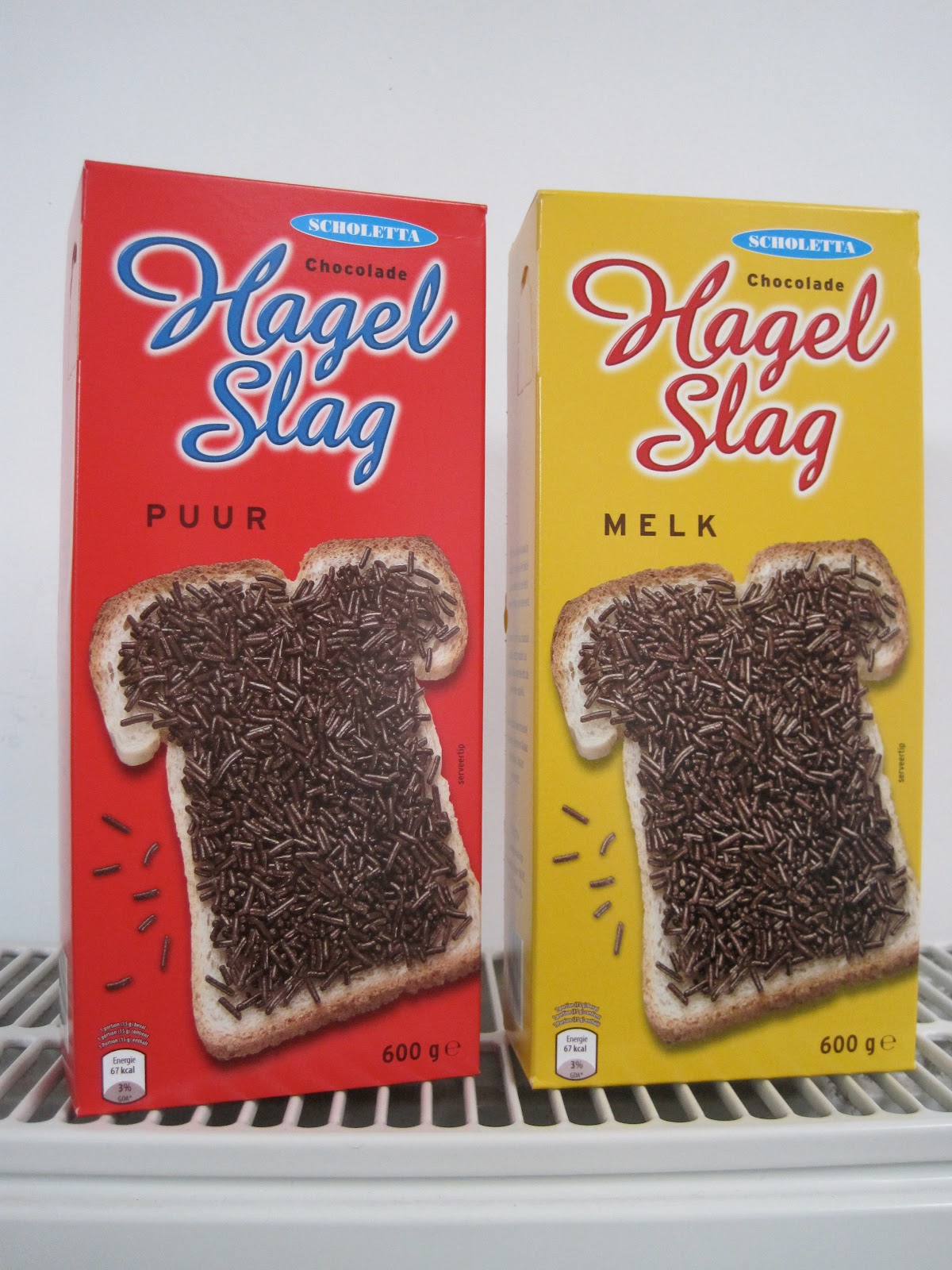
Hagel Slag

This post is long overdue. I can't believe I haven't written about Hagel Slag before now! (I think I overlooked it because I already introduced all my friends in L.A. to it when I was back there visiting a couple of months ago.)

Hagel Slag is what's known in the U.S. as chocolate sprinkles--the kind you buy in small quantities (if you bake) to put on cupcakes, or maybe ice cream sundaes. You can also find them on donuts. Usually they're used as a decoration, a finishing touch, if you will.

Well, Belgians have found a much larger gustatory purpose for the lowly chocolate sprinkle. Here, it's sold in large boxes (400-500 g) and used as a topping for bread or a sandwich filling, usually for breakfast. ("Hagel slag" means hail storm. Go figure.)

What you do is you take a slice of bread (or a roll) and spread it with butter, and then load it up with a solid layer of sprinkles. Voilà! Breakfast is served--or maybe lunch. You and I might call this "crazy" but I know at least one American who thinks it's "genius." A Belgian, of course, thinks it's normal.

Thursday, February 4, 2010

Fried potatoes

Everyone is familiar with the ubiquitous French fry, right? But not everyone knows that the French fry is actually Belgian. The story goes that American G.I.s first encountered fried strips of potato in Belgium during WWI and called them "French" because the Belgians spoke French.

This story is neat because it both explains the misnomer and shows Americans to be ignorant about European geography and national identity!

So anyway, not only did the Belgians invent French fries but they're something of a national obsession. Belgians eat a lot of fries. They're typically eaten with mayonnaise, but other sauces are available, or you can get them topped with goulash (a sweet-and-sour meat stew) or a kind of brown gravy. I have yet to see a Belgian put ketchup on their fries.

You can get your frietjes at a frituur, which is an independently owned snack bar that serves all kinds of fried foods in addition to fries, or at a frietkot, which I have yet to see but I'm told is an old-fashioned, typically Belgian fry shack. Fries are cooked to order and served in a paper cone.

The "meat snacks" (for want of a better term) at this frituur are beautifully displayed in a glass case. Most of them are a complete mystery to me. I've been slowly trying to figure out what everything is, either first-hand by eating one, or by asking friends. My favorite so far (in terms of admiration, not consumption) is the kipcorn, which is a log of processed chicken covered in what looks like corn flakes.

A word of warning: Do not, under any circumstances, order a hamburger at a frituur. You'll get something that resembles a burger in that it will be a patty on a bun, but the patty is not made from ground beef. I'm not sure what it's made out of... in taste and texture, it resembles an English banger. And it won't be cooked on a grill; everything is tossed into the deep fryer.

If you want to know more about Belgian fries, check out this website.